
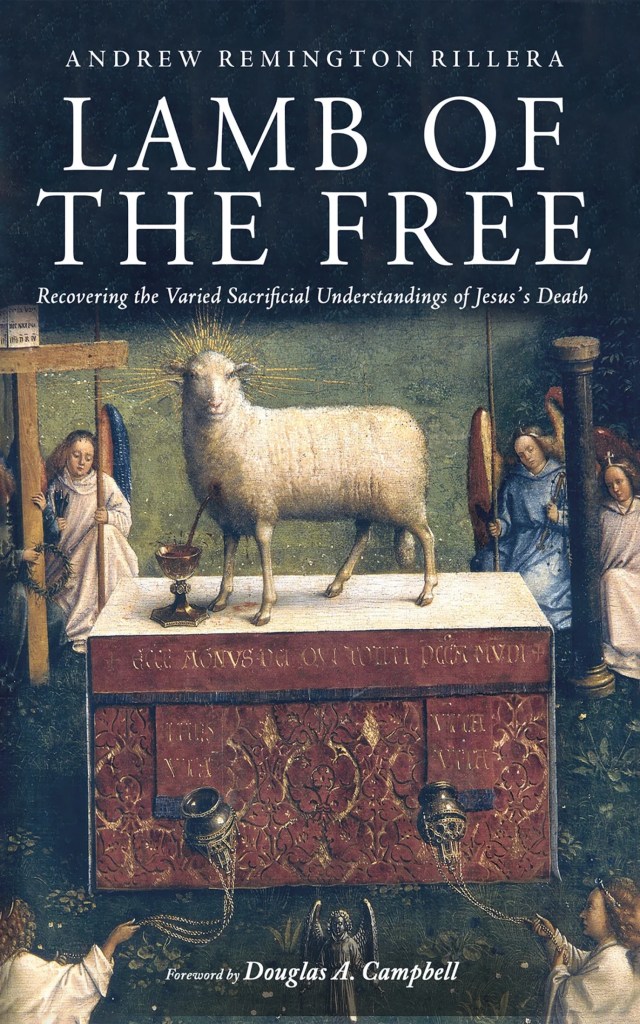
Last August, John Mark Comer offered full-throated praise of Andrew Remington Rillera’s Lamb of the Free: Recovering the Varied Sacrificial Understanding of Jesus’s Death, describing the book as the “knockout blow” to penal substitutionary atonement. Such a remark connected to any book about the atonement was bound to raise eyebrows. Comer eventually supplied context to his statement including the ways that he disagreed with Rillera’s treatment. Since that dust up a year ago, a handful of reviews of Rillera’s title have appeared. Like them, I will argue that Rillera’s study is seriously flawed. As a unique contribution, I will attempt to supply some wisdom principles for Christian readers.
This is a particularly lengthy review given the atonement’s centrality to the biblical message. The reader should feel free to jump to the section of greatest interest.
I. SUMMARY
II. EVALUATION
II.A. Strengths
II.B. Criticism
III. Special Discussion On Reading
IV. SPECIAL DISCUSSION On the Atonement
V. CONCLUSION
VI. FURTHER READING
SUMMARY
The twelve-page foreword by Rillera’s doctoral advisor, Douglas Campbell, sheds much light on this project. Near the end of the foreword, Campbell airs his concerns about penal substitution:
It follows further that the heart of the gospel [according to penal substitution] is a political and retributive God and arrangement—and hence that all politics should be fundamentally retributive as well… This model of the gospel then, underwrites political authoritarianism and God is essentially a dictator. He is a fair dictator but a dictator nonetheless, who wields the sword appropriately. (Campbell, xviii, emph. original)
Lamb of the Free, p. xviii, emph. original
This same concern is made explicit in Rillera’s own introduction.
I want to be up front about a deeper reason underneath this inquiry. My aim is ultimately to showcase the liberating message of the gospel as an act of resistance to other notions of “freedom” on offer in the world as represented in the US national anthem… [So the title’s pun on “land of the free.”]
I hope to ultimately dismantle these misunderstandings of justice and “the mutually reinforcing ways in which atonement theology has acted in the service of racialized narratives of punishment and control” [quoting Hannah Bowman] by being clear about what is and what is not actually happening in OT sacrifice and then how NT authors… make use of these sacrificial concepts.
Lamb of the Free, p. 2-3, emph. mine
Campbell’s Foreword and Rillera’s Introduction both present Lamb of the Free as a kind of protest against twenty-first century American Christian culture. So, while Rillera offers specific claims about the biblical text that can be evaluated in their own right, an unconcealed goal of this project is to move Christians away from a theology he believes is morally objectionable.
Rillera advances tons of claims and arguments concerning the biblical text. I’ll separate them into uncontroversial but significant claims and those that are more contentious. Let’s start with the first group:
- Not all sacrifices are atonement sacrifices (e.g. cereal offering of Lev 2). Crucially, Rillera reserves the English word group ‘atonement’ for the Hebrew word group kippur, independent of the history of translation.
- Ritual uncleanness and moral failure are not the same (e.g. childbirth is not a moral failure but causes ritual uncleanness, Lev 12).
- Jesus is the fulfillment of the Old Testament sacrificial system (Matt 5:17, Romans 10:4, Col 2:16-17).
Moving onto the second set, Rillera argues for the following more surprising positions:
- The Passover sacrifice is not about atonement or substitutionary death.
- No sacrifice in the Old Testament involves substitution or identification.
- Following Jacob Milgrom, the Day of Atonement is about the decontamination of holy places and objects.
- Sacrifice is not required for forgiveness even if sacrifice and forgiveness are associated.
In the final chapter, Rillera argues for a participatory concept of Jesus’ life and death, emphasizing Jesus’ solidarity with us and us with him. Rillera sees this as conceptually incompatible with any form of substitution:
Penal substitutionary atonement names the cross as what those who benefit from Jesus’s death necessarily get to escape since it is construed as “in our place” and “instead of us”… The consistent message throughout the entire NT is not that Jesus died instead of us; rather, it repeatedly indicates that Jesus dies ahead of us so that we can unite with him and be conformed to the image of his death.
Lamb of the Free, p. 274, emph. original
EVALUATION
I found this title to be incredibly frustrating. But there were some genuine strengths to which I will point before I raise concerns.
STRENGTHS
Participation in Christ’s Sufferings
Rillera is rightly attuned to the biblical theme of cruciform living. His slogan that Jesus died “ahead of us” as a model for life is undeniable. Perhaps especially in the United States, Christians are tempted towards a health-and-wealth gospel. Even those who would officially reject its teaching are tempted towards consumerism and the elusive goal of personal peace and affluence. The idea comes from a radicalized interpretation of some passages in the New Testament (Romans 8:28, John 10:10, 3 John 2). The issue, of course, is that nearly every book of the New Testament contains passages that call Christians to suffer for and with Christ (Matt 16:21-26, Rom 12:1-2, Phil 2:5-8, Col 1:24, 2 Tim 3:12, 1 Peter 4:1-6, 1 John 3:16). The American prosperity gospel receives only brief mention, but there is an affinity between it and what Rillera says bothers him about penal substitution, viz. that Jesus dies “instead of us” rather than “ahead of us.” I believe Rillera’s creating a false dichotomy, for as John Stott observes in his Cross of Christ, “Every Christian is both a Simon of Cyrene and a Barabbas. Like Barabbas we escape the cross, for Christ died in our place. Like Simon of Cyrene we carry the cross, for he calls us to take it up and follow him” (271). In any event, if someone reads the New Testament thinking that Jesus died so we don’t have to experience suffering of any kind, they probably haven’t read much at all.
Direct Writing Style
Rillera is explicit about what he’s doing: he wants to dismantle penal substitution because he believes it’s morally objectionable. While I don’t agree with him, he’s giving us more to work with by making that fact explicit in the introduction. If he’d left this goal unstated, it would limit our ability to interpret him. One might sense from the rest of the book that he has an axe to grind, but it’s quite helpful for Rillera to show us his axe and grindstone.
Rillera’s direct writing style is also exemplified by his beginning every chapter with an enumerated list of theses. One can take or leave any of the arguments for those theses, but Rillera leaves no doubts concerning the aim of his arguments.
The Bible, The Whole Bible, and Nothing but the Bible
In making his case, Rillera draws on the entire Bible. Generally, it can be tempting to quarantine something objectionable in Scripture. For example, when faced with all the disturbing stories of the Old Testament, or the weird rituals, the average Christian is tempted to focus on the New Testament. On this thinking, the weirdness can stay back there in the Jewish part, in the law part. “I’m into the Jesus part, the grace part,” one says. Examples of carving up the Bible to suit the present culture’s interests are manifold. Serious Christians and readers of the Scripture know that this won’t do. The posture of devoted Christians is to get under the authority of the Scripture, rather than impose our authority upon it by picking the parts we like and discarding the rest.
As it concerns the specific temptation to leave behind Old Testament weirdness, Rillera rightly and admirably resists. Jesus and the Apostles quote extensively from the Old Testament. They were all Jewish. Jesus revered the law (Matt 5:18-19), followed the law (2 Cor 5:21, Heb 4:15, cf. Gal 4:4) and indeed viewed himself as the fulfillment of the law (Matt 5:17; Luke 24:27)! So, Rillera laudably interacts with the entirety of the Bible in attempting to address the ostensible source of penal substitution.
CRITICISM
Some of my concerns with this title will be expressed in the special discussions below. Here I will address some of Rillera’s specific claims about the text of the Bible and his lack of theological finesse.
General Issues
As a broad umbrella complaint, Rillera appears to be unacquainted with how debates are conducted. Granted, I studied logic and so I’m acutely sensitive to those types of issues. But all scholars debate and are subject to the canons of debate. More concretely, Rillera seems to be unaware of how a defender of penal substitution might respond to his naked assertions. The best writers take seriously what their opponents think, and even if those thinkers haven’t responded to a particular argument, these writers will imagine the strongest possible response and defend themselves against it. Unfortunately, Rillera tends to represent his opponents as ignorant or foolish, if he represents them at all. What I see in Lamb of the Free is one straw man after another.
Another serious issue for Rillera’s scholarship is that he frequently misrepresents the authors he cites. This doesn’t bode well for his biblical exegesis. First, he cites Hannah Bowman’s article favorably, but ignores statements of hers like these, “Here is where I propose that the language of substitution is helpful,” followed by a discussion where substitution and solidarity work together. Despite this, Rillera avoids countenancing any notion of substitution. Second, he presents Douglas Moo’s interpretation of Romans 3:25 as, “Paul wanted to say ‘atoning sacrifice,’ but used the wrong word” (Rillera, 269). Anyone familiar with Moo would know that he’s not likely to have said that. I reviewed the relevant section of Moo’s Romans commentary and found nothing of the sort. Whatever Rillera believes he’s paraphrasing, it’s a gross distortion of Moo’s words. Finally, due to Rillera’s presentation, I expected Simon Gathercole’s book, Defending Substitution to be the smoking gun. I anticipated a clumsy defense of penal substitution. What I found instead was a thoughtful essay containing carefully circumscribed statements like these found in the introduction:
It should be emphasized, however, that the argument here does nothing to undermine the importance of representation and participation [Rillera’s view]. Rather, the point is that substitution can happily coexist with them.
Defending Substitution, p. 14
A number of elements of the atonement—propitiation, punishment of sin, representation, expiation, for example—that are often taken together may indeed rightly be taken together, but it is important to recognize that each of them must be derived from Scripture and not be seen merely as mutually entailing. Substitution is logically distinguishable from related concepts such as penalty, representation, expiation, and propitiation. This is not to say that they cannot all belong together in a full-orbed understanding of the atonement. But it is to say that each must arise out of exegesis and can, indeed should, be the subject of investigation in its own right. They are logically distinct rather than a priori inseparable.
Defending Substitution, p. 18
After reading Gathercole, I wasn’t just frustrated by Rillera’s misleading characterization of him, but I wish Rillera had exhibited the same conceptual self-awareness exhibited by Gathercole.
Specific Biblical Claims
Let’s evaluate (4)-(7) above. This part gets a little technical. Casual readers are free to skip to the next section.
- The Passover sacrifice is not about atonement or substitutionary death. Central to Rillera’s argument is that ‘kippur’ is never used in the descriptions of the Passover, and ‘zabah’ (sacrifice) isn’t used of the first Passover. Rillera is right to point out that the Passover does not take the normal shape of an atoning sacrifice. At least one unusual aspect of the first Passover is that the endangered person is the first-born of a household, not the nation (as in the Day of Atonement), nor an individual lawbreaker (as in guilt offerings). Nevertheless, does anyone who connects the Passover to penal substitution claim that it is exactly like the sacrifices of Leviticus? More likely, they would suggest, as I do, that it follows a pattern found within the Pentateuch where a display of blood averts God’s judgment. Furthermore, I’m not aware of anyone who claims that the Passover celebration prescribed after the exodus is an instance of penal substitution—it’s obviously a memorial of the exodus event. What makes all of this even more strange is that Rillera argues that the blood of the first Passover protects the household or “wards off” (53) the destroyer. His verbal substitute—pun intended—feels like a semantic game. The same structure is present: an animal dies, the first-born lives.
- No sacrifice in the Old Testament involves substitution or identification. Rillera focuses on the hand-laying procedure, claiming that it’s a ritual act claiming, “this is mine,” not “this is me.” The substance of this claim comes from the fact that obviously non-atoning sacrifices (see Lev 3:2) also require hand-laying. I see three issues:
- It’s fair to say that a broad use of hand-laying should raise questions about its meaning, but it’s too strong to say that this cannot be a statement of identification anywhere. Ownership and identification are kindred concepts, especially within the context of presenting an offering to God.
- Leviticus 16 explicitly involves confessing the sins onto the scape goat with two hands. Granted, this is the goat that is sent into the wilderness (not ritually killed). But that closely resembles God sending Adam and Eve out of the garden, and Israel out of the Promised Land. Exile is God declaring, “You may not dwell with me anymore.” Death and exile are closely connected, with death forming a specific and especially severe form of exile (cf. Gen 2:17, 3:23).
- Leviticus is puzzling, especially given the way that law-court imagery blends with sacrificial-temple imagery; e.g, the throne of the Judge is the mercy seat (Ex 25:22, 2 Sam 6:2, Ps 99:1, cf. Ps 123:1). Exactly how its parts link in with the rest of Scripture takes real work. Even if we grant Rillera everything he wants to say about the sacrificial system and its function, we must still confront the fact that identification and substitution are biblical concepts. One of the most striking examples of this is the famous Isaiah 53 (especially vv. 4-6), which is among the most quoted passages in the New Testament. There are more examples to be discussed below in the SPECIAL DISCUSSION On the Atonement.
- It’s fair to say that a broad use of hand-laying should raise questions about its meaning, but it’s too strong to say that this cannot be a statement of identification anywhere. Ownership and identification are kindred concepts, especially within the context of presenting an offering to God.
- The Day of Atonement is about the decontamination of holy places and objects. Throughout the book, Rillera argues that kippur sacrifices are for cleansing holy places and objects (e.g., the altar, the censers, etc.) Furthermore, the kippur sacrifices apply not to the one offering the sacrifice (supplicant), but to the holy places and objects. A few alarm bells go off when I read these claims.
- The idea that the kippur sacrifice doesn’t apply to the supplicant is not supported by the text. The expression, “atonement for” the supplicant appears over a dozens times in Leviticus (1:4; 4:20, 26, 31, 35; 5:6, 10, 13, 16; 6:7; 8:34; 9:7; 10:17; 12:7-8; 14:18-21, 29; 15:15, 30; 16:6, 11, 17, 24, 30, 17:11). It’s true that holy things are cleansed by sacrifices (8:15, 16:16, 18, 19, 20), but that’s not in opposition to, but together with (16:33) the supplicant. Milgrom’s discussion of kippur—upon which Rillera heavily relies—also appears to be based on etymological and comparative linguistic evidence that links kippur to “smearing,” or “wiping” (cf. Gen 6:14). While etymology is useful, it’s not the same as meaning (cf. Carson on the Root Fallacy). Given that kippur’s range of usage bursts the bounds of cleansing, I’m reluctant to concede its meaning so freely to Milgrom or Rillera. Kippur appears to include but isn’t limited to cleansing. This shouldn’t surprise us since much of Leviticus involves a mix of dealing with sin and ritual uncleanness. The boundary between these isn’t sharply fixed even if they’re not the same.
- Suppose we grant that kippur is only (or primarily) about cleansing. Rillera emphasizes the holy places and articles. There is limited discussion on why we should care. What makes those things holy (cf. Matt 23:16-22)? And why does sin contaminate? Is it just some magical aspect of holy things? No, it’s because God is hostile towards human wickedness. He cannot dwell with the wicked (Psalm 5:5-6). The system is designed to reflect an aspect of God’s nature and his relationship to man (Hebrews 8:5, cf. Ex 25:40) Furthermore, I sense that we haven’t really escaped the ostensible weirdness of penal substitution. As I complained in (4.) above, the new structure closely resembles a penal substitution structure. In penal substitution, sin requires death to avert God’s judgment. In Rillera’s preferred understanding, sin pollutes the places where the holy God dwells and must be cleansed. These are awfully similar in structure. Backing up, what do you see? Someone sins, an animal dies, the sinner carries on.
- The idea that the kippur sacrifice doesn’t apply to the supplicant is not supported by the text. The expression, “atonement for” the supplicant appears over a dozens times in Leviticus (1:4; 4:20, 26, 31, 35; 5:6, 10, 13, 16; 6:7; 8:34; 9:7; 10:17; 12:7-8; 14:18-21, 29; 15:15, 30; 16:6, 11, 17, 24, 30, 17:11). It’s true that holy things are cleansed by sacrifices (8:15, 16:16, 18, 19, 20), but that’s not in opposition to, but together with (16:33) the supplicant. Milgrom’s discussion of kippur—upon which Rillera heavily relies—also appears to be based on etymological and comparative linguistic evidence that links kippur to “smearing,” or “wiping” (cf. Gen 6:14). While etymology is useful, it’s not the same as meaning (cf. Carson on the Root Fallacy). Given that kippur’s range of usage bursts the bounds of cleansing, I’m reluctant to concede its meaning so freely to Milgrom or Rillera. Kippur appears to include but isn’t limited to cleansing. This shouldn’t surprise us since much of Leviticus involves a mix of dealing with sin and ritual uncleanness. The boundary between these isn’t sharply fixed even if they’re not the same.
- Sacrifice is not required for forgiveness even if sacrifice and forgiveness are associated. Rillera argues that forgiveness does not require sacrifice or atonement. The heretical Socinians along with Muslims also hold to this teaching. I don’t offer that remark to say that Rillera’s bad company makes him wrong—that would be an ad hominem. I offer those examples to indicate that Rillera’s ideas are not new and that they’ve been capably answered many times over the centuries.
There is a theological concern here as well as an exegetical one. The theological one derives from a concern that the sacrificial system, or judicial requirements, constrain God, but—so the argument goes—God should have the freedom to forgive at will. This seems to face the same issues as any extreme form of divine voluntarism: can God declare by fiat that murder is morally acceptable? The main reason anyone resists divine voluntarism is that God is not capricious. I deny that God forgives at will because it’s unjust and unloving. It’s unjust due its arbitrariness, and unloving towards the victim of the sin by favoring the perpetrator. I don’t recall Rillera depending as much on these theological arguments, but they’re relevant to the history of the discussion.
Rillera’s arguments depend more on biblical exegesis. There are numerous passages where God appears to forgive someone without mention of a sacrifice (e.g. the parable of The Unmerciful Servant, David’s sin). The problem is two-fold.
- Scripture seems to contain more than one kind of forgiveness. It’s tempting to treat single words in the Scripture as though they’re technical scientific expressions with a single, unambiguous meaning. The Bible is not designed to be read like a scientific or philosophical textbook where all the terms are precisely defined. Some portions of Scripture are more that way than others, but it also contains stories, and, in the case of Jesus’ teaching, parables that are meant to be understood by a wide audience. So, in the specific case of ‘forgive’ it’s worth note that there is an absolute sense of ‘forgive’ which determines one’s ability to enter God’s presence, including the forgiveness granted by the sacrificial system (cf. Isaiah 6:5-7). There is also a sense of ‘forgive’ that is connected to one’s place within God’s plan on earth (cf. Romans 9-11). Examples include God forgiving David in allowing him to remain king despite his adultery and murder of Uriah. Negative examples abound where it says that God will not forgive (see Ex 23:21, Josh 24:19, 2 Kings 24:4, Hosea 1:6). These are much clearer in demonstrating that multiple senses of ‘forgive’ must be in play, since few interpreters would interpret these to mean that God is sending the person or nation to hell. As it connects to the theological discussion above, I believe God has more freedom in the second sense even if I deny that it’s capricious or arbitrary.
- The New Testament represents Jesus’ sacrifice as once-for-all (Rom 6:10; 2 Cor 5:14; Heb 7:27, 9:12, 26, 10:2, 10:10; cf. 1 Tim 4:10, 1 John 2:2, 1 Peter 3:18). It therefore covers all sin. Forgiveness is then received by placing our faith in that work. In other words, given the absoluteness of this sacrifice, there is no such thing as forgiveness without sacrifice (cf. Heb 9:22). Moreover, a few choice New Testament passages (Rom 3:25, Heb 9:9-10, 10:4) imply that Levitical sacrifices never succeeded to deal with sin, and that God patiently endured human sin until Jesus died. Of course, someone may disagree with this interpretation and argue against it, but they must supply a superior explanation and interpretation of this textual material. Incidentally, this same material demonstrates the uniqueness of Jesus’ sacrifice. While we are called to a life of sacrifice for Christ (Romans 12:1), some things he does alone. The uniqueness of his death is not just a matter of its being first.
- Scripture seems to contain more than one kind of forgiveness. It’s tempting to treat single words in the Scripture as though they’re technical scientific expressions with a single, unambiguous meaning. The Bible is not designed to be read like a scientific or philosophical textbook where all the terms are precisely defined. Some portions of Scripture are more that way than others, but it also contains stories, and, in the case of Jesus’ teaching, parables that are meant to be understood by a wide audience. So, in the specific case of ‘forgive’ it’s worth note that there is an absolute sense of ‘forgive’ which determines one’s ability to enter God’s presence, including the forgiveness granted by the sacrificial system (cf. Isaiah 6:5-7). There is also a sense of ‘forgive’ that is connected to one’s place within God’s plan on earth (cf. Romans 9-11). Examples include God forgiving David in allowing him to remain king despite his adultery and murder of Uriah. Negative examples abound where it says that God will not forgive (see Ex 23:21, Josh 24:19, 2 Kings 24:4, Hosea 1:6). These are much clearer in demonstrating that multiple senses of ‘forgive’ must be in play, since few interpreters would interpret these to mean that God is sending the person or nation to hell. As it connects to the theological discussion above, I believe God has more freedom in the second sense even if I deny that it’s capricious or arbitrary.
SPECIAL DISCUSSION On Reading
One of the things that has me scratching my head is not just Comer’s (semi-retracted) endorsement, but how did someone like John Mark Comer come to believe that this was a serious treatment of these matters? Comer’s not the only one. Madison Pierce, a scholar of the book of Hebrews connected to reputable institutions (TEDS, Western Theological, and now St Andrews) warmly endorsed this book. Did Comer and Pierce read the same thing I did? Are people so eager to reject penal substitution that anything that opens that possibility up is received with an open hand? I have no idea what people’s motives are for their endorsements, but this title had numerous yellow and red lights for me as a reader.
Yellow Lights
These yellow lights are areas that give me pause in assessing Rillera’s credentials to write a book on this topic. They are not disqualifying, but they impact his reliability as an authority. For each, I will offer a summarizing question to use for any book one might read.
- What are this author’s professional credentials? Upon release, Andrew Rillera was a junior scholar (Assistant Professor) of an extremely small institution. The King’s University in Alberta, Canada has fewer than 1000 students enrolled, and has one biblical scholar in its faculty: Rillera. This implies that Rillera is not directing PhD students, nor participating in a vibrant research community. He might one day! But the point is that this slows me down a little bit. It’s a yellow light.
- Upon what does the author ground his/her arguments? The bibliography of this book has about 125 titles (estimated) for 285 pages. That sounds large to an average reader, but shorter academic titles frequently have double that number of references. For comparison, I personally wrote a ~40-page article with more references than Rillera. Again, does this mean Rillera doesn’t have authority? Is there some minimum number of references to make one’s writing authoritative? Of course not! But when someone challenges a widely held doctrine and does so attempting to be a part of an academic discussion of that doctrine, I would expect that person to exhibit greater familiarity with that literature.
- What is this author’s area of expertise? One of the more serious issues is that Rillera’s graduate research is in New Testament and Lamb of the Free is mainly about the Old Testament. Rillera studied under Douglas Campbell, a Pauline scholar at Duke. Rillera’s dissertation covered the first few chapters of Romans. Am I saying Rillera can only write in his specific research area? Of course not! Someone smart enough to write a dissertation could in principle begin another book-length research project. But when I see a young researcher writing in an area outside his proven expertise, that’s a yellow light. I’m approaching the question of his authority with caution.
- Is the writing style appropriate to the topic? Is it harmonious with the author’s credentials? The previous examples are from learning about the man Rillera. The final yellow light for me is the polemical tone of this project. It’s hard to avoid thinking of Rillera’s introduction at this point. Perhaps as the flip side of the appealing directness in Rillera’s style, his writing can also be belligerent. Obviously, a surly writing style doesn’t falsify a writer’s assertions. But, as before, it sets up a yellow light for me. The tone implies that Rillera will not thoughtfully and carefully measure the relevant evidence.
Red Lights
As I began to read Rillera, attempting to be somewhat charitable, there were some assertions that made me hit the brakes. These were the kinds of statements that severely harmed my trust in his ability to carefully sift biblical data or theological arguments.
- In the introduction, Rillera quotes from Hannah Bowman’s article, “From Substitution to Solidarity.” Bowman and Rillera both claim that America’s mass incarceration is driven by the retributive justice concept underlying penal substitution. First, even if this link is sustainable, it’s irrelevant. Just about every true doctrine of Christianity has been misappropriated and abused at some point. Rillera with Bowman need to consider, how might ignorant or foolish people misuse their preferred theory of the atonement?
Second, this connection to our current criminal justice system is undermined by the following observations. (i) A retributive model would lead mainly to capital punishment for any form of murder. But the number of convicted murderers vastly outstrips the number of death row inmates, and there are even fewer who receive the death penalty. (ii) The ancestral form of modern American incarceration emerged not from retribution, but partly due to a loophole created by the thirteenth amendment, viz. slavery is permissible for prisoners. (iii) Christian ministries have served in prisons for decades while preaching penal substitution without embarrassment. Despite the doctrine of penal substitution, many prisoners experience transformation and restoration.
Fundamentally, Bowman and Rillera are making public policy claims that require both historical and scientific evidence, neither of which are on offer. Notably, Bowman largely cites other morally sensitive theologians. Many of these, like her, make their case from impressionistic and conceptual associations. Few to none of the arguments are based in legal, political, or historical scholarship even though their claims could easily be subject to scientific scrutiny. Of course, I have no desire to defend the American criminal justice system. But whatever concerns one might have, the link between a complex historical institution like the American penal system and a specific doctrine of atonement is pretty flimsy. Such a link ironically indulges the strange right-wing hypothesis that America is (or was) a Christian nation. - Drawing on Lev 17:3-4, Rillera states, “According to Leviticus, killing a domesticated animal is morally equivalent to murdering a human being.” Anyone who has read Leviticus would immediately think something has gone wrong. There are some straightforward reasons to think this can’t be right. (i) Killing humans carries with it capital punishment, not mere removal from society as in 17:4 (Lev 24:17, Exodus 21:12ff, cf. Numbers 35:10ff). See especially Lev 24:21 where the killing of animals and of humans are directly contrasted. (ii) Killing animals doesn’t carry with it this same punishment anywhere else (Ex 21:33ff, Deut 12:15-25, cf. Numbers 11:21-22). (iii) I’m no expert, but basic aspects of animal husbandry seem to cut against Rillera’s remark. It’s hard to imagine that God would consider a shepherd killing a diseased sheep an act of murder. Such an act is neither for food nor for ritual and would be primarily for the purpose of protecting the rest of the flock. Without qualification, Rillera is saying that such protective measures are the same as murder.
So what went wrong? Lev 17:3-4 says that to kill an animal is to be guilty of ‘bloodshed’. Of course, if we take that statement without any context, then it sure looks like Rillera is correct. The problem is that ‘bloodshed’ has a specific meaning in Leviticus 17. Blood is exclusively reserved for ritual use in the tabernacle. Lev 17 is not prohibiting the shedding of animal blood in any circumstances but the shedding of blood for ritual purposes apart from the prescribed place (see the very next verse!) What I find especially baffling is that Rillera later admits that animals can be killed without penalty based on Deuteronomy 12:15-25. So then, why make the earlier stark and unqualified statement?
Ultimately, for someone presenting himself as an expert on Levitical sacrifice, this is at best an irresponsible way of presenting things.
SPECIAL DISCUSSION On the Atonement
I want to conclude with a brief discussion on the atonement debate. Unfortunately, debates over the atonement can create more heat than light. Here are some observations that I hope will help readers return to shore when they feel adrift.
First, in reading on atonement, ask:
- How does the author define ‘atonement’?
- What is the question under investigation?
- What methods does this author use to discover the answers to these questions?
These are beginning-point, end-point and path-between questions. Part of what makes these issues so frustrating is that people answer these questions in significantly different ways but use the same English word. They begin fighting before they recognize that they’re not even discussing the same thing. For example, some people use the word ‘atonement’ as a shorthand for penal substitution. Some authors are strictly interested in what the Hebrew term kippur means. Some authors use atonement to abstractly denote whatever mechanism God deploys to reconcile mankind to himself. Some of these are addressed within New Testament studies, some within Systematic Theology. Naturally, all of these connect to each other, but Christians often noisily argue at the level of penal substitution when their disagreements are more foundational.
Second, penal substitution is not a single view, but an overarching phenomenon that can be witnessed in Scripture. No doubt, there are articulations of penal substitution that are offensive, weird, and unbiblical:
- We should resist any idea that Jesus unwillingly gave up his life for us (John 10:18, cf. John 5:26).
- We should resist the idea that gentle Jesus shields us from the frothing fury of the Father (cf. John 3:16, John 5:22).
- We should also resist any presentation of penal substitution where God’s love and God’s justice are truly in conflict. It’s rhetorically useful to portray these as in tension, but God’s different attributes don’t conflict with one another. Justice is best represented as flowing out of God’s love, not as a binding force upon him.
However, to completely repudiate any notion of penal substitution requires almost willful blindness to tons of passages (Matt 26:28, Mark 10:45, Rom 4:25, 5:6-8, 6:10; 1 Cor 15:3; Gal 1:4, 2:20, 3:10-14; cf. Rom 14:15; 1 Thess 5:10). I’m especially struck by 1 Peter 2:24, which not only quotes from Isaiah 53, but represents Jesus’ bearing of sin in his body on the cross:
1 Peter 2:24 (niv) “He himself bore our sins” in his body on the cross, so that we might die to sins and live for righteousness; “by his wounds you have been healed.”
Even NT Wright—no champion of penal substitution—still grants its presence in Scripture. In What Did the Cross Accomplish (with Simon Gathercole and Robert B. Stewart), Wright remarks on Romans 8:1-3, “Now that is definitely penal: Paul is speaking of ‘condemnation.’ And it is definitely substitutionary. Jesus dies, so therefore there is ‘no condemnation’ for us” (Wright et al., 46).
Finally, Jesus is portrayed in the New Testament as casting a typological “shadow” into the Old Testament (Col 2:16-17). This means that he’s not merely a completion or fulfilment of Old Testament concepts, but even more strongly, Jesus’ life, death, and resurrection is the source and ground of these rituals. The profound mystery of the person and work of Jesus will necessarily outstrip all the different images that point ahead to him. That does not mean anything goes, or that they’re inscrutable. What it means is that no matter how penal substitution maps onto the Levitical system, neither penal substitution, nor the rituals tell the whole story. The cross frees us from slavery to sin as well averts God’s judgment (Rom 5:9-10; Gal 3:10-14; Heb 2:9; 1 Peter 1:18-19); the cross reconciles us to our Heavenly Father as well as propitiates the wrath of the Triune God (Col 1:21-22, 1 John 4:10; cf. Eph 2:3-7). Each of these is meant to portray an aspect of the glorious singularity of the cross.
CONCLUSION
We may appreciate Rillera’s insistence that penal substitution isn’t everything, but we must resist his conclusion that it isn’t anything. As for what Rillera “knocked out,” it’s nothing more than a straw man that he’s draped in penal substitutionary garb.
FURTHER READING
Due to how consequential this topic is, I would urge readers looking for more to consult the following resources.
On Atonement and the Cross
- Butler, Geoffrey (2021) “Appeasement of a Monster God? A Historical and Biblical Analysis of Penal Substitutionary Atonement,” Themelios 46:1.
- Packer, J.I. (2023) What Did the Cross Achieve? Wheaton, IL: Crossway.
- Stott, John R.W. (2021) Cross of Christ. Downers Grove, IL: IVP.
On Leviticus
- McDaniel, Roy Edmonds. (2025) Enacting Atonment: The Narrative Logic of Sacrifice and Sonship in Leviticus.Downers Grove, IL: IVP.
- Morales, L. Michael (2015) Who Shall Ascend the Mountain of the Lord? Downers Grove, IL: IVP.
Related Carson Center Articles
Other Reviews of Rillera
- Jay Sklar on TGC (shorter), on Themelios (longer)
- Derek Rishmawy on Mere Orthodoxy


