
[This is an earlier review I wrote roughly five years ago.]
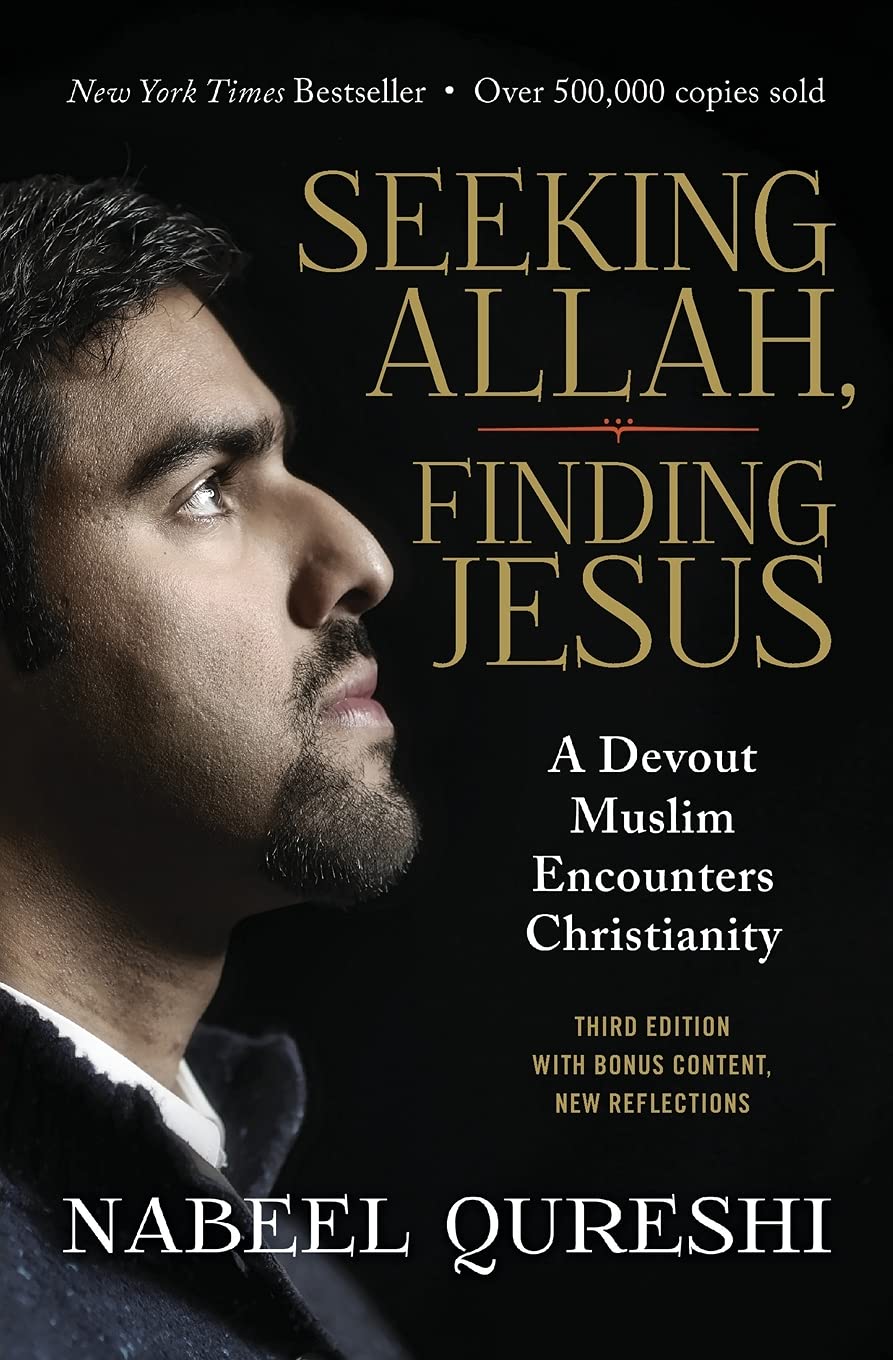
Seeking Allah, Finding Jesus (SAFJ) was the most compelling book I’ve read in years. For my job, I read numerous titles: most of them in tandem, picking them up and putting them down, whittling chapters away over months. Not so here: I could not put down Qureshi’s very personal, gripping tale of coming to faith in Christ.
Approaching a book like this, a Christian believer might be tempted to reason as follows: Islam is a merciless religion of hate and violence. Qureshi surely had a miserable childhood under the draconian rule of his parents and imams. He bore this heavy burden joylessly but dutifully, because it was all he knew. No doubt, upon discovering the good news of freedom in Christ, he tossed off Mohammed’s heavy shackles in exchange for the easy yoke of faith in Christ. Qureshi’s story is far more fascinating than this one-dimensional portrait. Qureshi is the Muslim Saul of Tarsus: he had a joyful childhood; he had a loving family; he was part of a warm Muslim community; he loved Islam and the Quran; he was a top student, receiving his MD; he was morally upright by almost any standard; and his family was financially comfortable. Like Saul, when he surrendered to Christ, he had much to lose and little to gain. But also like Saul, he couldn’t deny the truth of the risen Jesus Christ. SAFJ chronicles Qureshi’s journey from his happy Muslim childhood up to just past his conversion.
Philippians 3:4b-7 (NIV) If someone else thinks they have reasons to put confidence in the flesh, I have more: circumcised on the eighth day, of the people of Israel, of the tribe of Benjamin, a Hebrew of Hebrews; in regard to the law, a Pharisee; as for zeal, persecuting the church; as for righteousness based on the law, faultless. But whatever were gains to me I now consider loss for the sake of Christ.
The book is divided into ten sections and a whopping fifty-three chapters. Don’t worry, the main body of the book doesn’t break 300 pages; indeed, the shortness of the chapters only increases its readability. The first section begins gives a window into some of ins-and-outs of orthodox Islam while mingling details about Qureshi’s very early life. This section is valuable in its own right, given the place Islam occupies in current national discussions. Much of the rest of the book involves Qureshi’s struggle against Christianity during his years in college, as well as his close friendship with a young Christian named David. Again, if only for the sake of seeing David’s skill in friendship evangelism, the book would be worth the read. Throughout, one learns about how Muslims view the Bible and Jesus; one learns striking details about Mohammed, the origins of Islam and the Quran; one also learns why so many Muslims are ignorant of such reliable and easy-to-access information about their own religion. The book also provides a decent apologetic for biblical Christianity, especially the resurrection.
I give this book my highest recommendations. Viewed as a text on apologetics, SAFJ is lively read filled to the brim with the relationship between biblical Christianity and Islam. Viewed as an autobiography, one can’t help but get caught up in Qureshi’s inner experience of torment as he faces the prospect of leaving behind the beloved religion of his family.

 A Critical Reeder